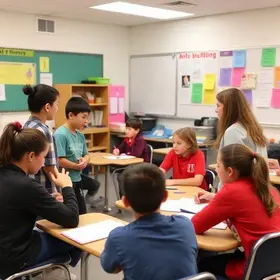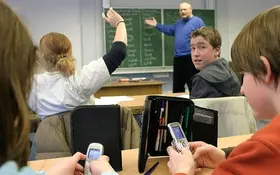
School vouchers are a source of debate between public and private schools nationwide, but nowhere is the debate more acutely felt than in Indiana. Indiana is home to one of the largest voucher programs in the country, and many are waiting to see whether this program delivers on all of its promises. Vouchers are also a major point of contention in places like Wisconsin and Louisiana, where schools are fighting for students and parents are waiting to see if the benefits of school choice will come to fruition. Do vouchers improve the quality of education for all students? With inconclusive test results, the jury appears to still be out. However, that doesn鈥檛 change the intensity with which both sides fight for the type of education system they believe is best.
Competition Heats Up in Indiana
Indiana鈥檚 school voucher program continues to expand, intensifying competition between public and private schools. The state鈥檚 , first approved by the Indiana legislature in 2011, has grown into one of the largest voucher initiatives in the country. According to the Indiana Department of Education鈥檚 overview of the program, tens of thousands of students now use vouchers to attend participating private schools, and participation has increased steadily as eligibility rules have expanded. As the program grows, many public school districts have worked to retain students by promoting their academic programs, extracurricular opportunities, and community connections, while also adapting to the financial impact that occurs when enrollment shifts away from traditional public schools.
Indiana鈥檚 Choice Scholarship Program has expanded dramatically since its launch in 2011. By the 2024鈥�2025 school year, more than 76,000 students were participating, with nearly $497 million in state funding supporting public school tuition assistance statewide. The program has grown well beyond its original cap and eligibility limits. In recent years, lawmakers expanded income thresholds to include most middle-income households, and legislation passed in 2025 will remove remaining income restrictions beginning with the 2026鈥�2027 school year, effectively making vouchers available to all Indiana families regardless of household income. See the Indiana and recent reporting on program growth.
Advertising Dollars Spent
In response to the mass exodus of students from some Indiana schools, districts are launching ad campaigns to alert families to the changes being made in the public school system. Fox News cites public schools in the state that have purchased air time on radio stations and billboard space to lure families into staying or returning to the public school districts. One school district in the state spent $5,700 on two billboards to advertise their school programs. This amount is similar to what a school loses in funding every time a student leaves the public school system, which ranges from $5,300 to $8,400.
The Fort Wayne school district has launched a major ad campaign to the tune of $32,000. This campaign, titled 鈥淭heir Stories. Your School. Get Back to School at FWCS,鈥� features students from the district who have succeeded in the public school. The campaign is also directed at alerting parents and students to test scores and the graduation rate for the district, which currently stands at around 90 percent. Last year, Fort Wayne lost 392 students to the voucher program, which cost the district more than $2.6 million and forced district administrators to cut 10 music, art, and physical education teachers.
This video offers a look at vouchers from a research perspective.
Promoting Choice
The voucher program in Indiana isn鈥檛 just about choosing private schools. The reports that the program also allows students to attend any public school of their choice. Some believe that extending choice has had benefits for Indiana students. Public schools, forced to compete with many other options, have been forced to raise the bar on their education quality. Some have purchased technology for students that was never available in public schools. Supporters of Indiana鈥檚 school choice policies argue that expanded options create competitive pressure that can motivate public schools to innovate and improve academic programs. Critics, however, question whether competition alone produces measurable academic gains, particularly as the program continues to grow and serve a wider range of families.
Social justice, a concern for left-leaning supporters of vouchers, is another factor examined in the Indiana voucher program. Proponents of the program say that Indiana is also hitting the mark here since most students participating in the voucher system also qualify for free or reduced-price lunches in the state. Those earning a moderate income can also take advantage of the voucher system for a reduced value than those with greater financial need.
This video offers a look at vouchers from a teacher's point of view.
What the Tests Say
With the debate continuing, many believe it is time to turn to concrete evidence that voucher programs are improving educational quality. Due to a lack of a better benchmark, these educators turn to test scores to determine whether the programs are meeting their goals. However, the evidence supporting vouchers is shaky in this area. Researchers and policymakers continue to study the academic outcomes associated with voucher programs. Some studies have shown mixed or inconclusive results when comparing standardized test scores between voucher recipients and traditional public school students. Because the Indiana program has expanded significantly in recent years, education researchers note that long-term data will be necessary to evaluate its full impact on student achievement. However, it has been pointed out that with a large influx of new students, drops in test scores should be expected. Educators will need to wait for more evidence before determining this state.
Research on voucher programs in other states, including long-running programs in places like Milwaukee, has produced mixed findings. Some studies suggest modest gains in certain academic outcomes, while others find little measurable difference between voucher students and their peers in public schools. Because methodologies vary, education experts frequently caution that results should be interpreted carefully. The president of School Choice Milwaukee, Jim Bender, told the Journal-Sentinel that better uniformity is required in studies to ensure more accurate results.
While the jury may still be out from a test score standpoint, there are still strong feelings on both sides of the voucher issue. At this point, only time will tell whether school choice will provide the educational benefits promised.
Conclusion
The debate over school vouchers continues to shape education policy in Indiana and across the United States. Supporters view vouchers as a way to expand opportunity, giving families greater freedom to choose schools that align with their children's needs. Critics remain concerned about the potential impact on public school funding and whether voucher programs consistently deliver stronger academic outcomes.
Indiana鈥檚 rapidly expanding Choice Scholarship Program illustrates both the promise and the complexity of school choice initiatives. As participation grows and eligibility broadens, policymakers, educators, and families will continue to watch closely for measurable results. Test scores, graduation rates, and long-term student outcomes will play a central role in determining whether vouchers achieve their intended goals.
For now, the discussion remains active and often polarized. What is clear, however, is that school vouchers have become a permanent and influential part of the education landscape. As states refine their policies and new data emerges, the future of school choice will likely remain one of the most closely watched issues in American education.
Questions or feedback? Connect with 麻豆果冻传媒 on Facebook: