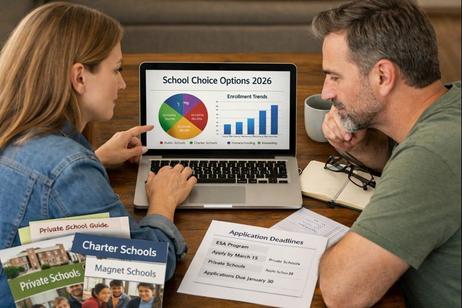
School choice continues to reshape the public education landscape in 2026. Across the country, families are navigating open enrollment policies, charter school growth, education savings accounts, and inter-district transfers. At the same time, traditional public school districts are adapting to enrollment shifts and funding changes.
For parents, the expanding range of options can feel overwhelming. This guide explains how school choice works in 2026, how it affects public schools, and what families should consider before making a decision.
What 鈥淪chool Choice鈥� Means in 2026
School choice refers to policies that allow families to select educational options beyond their assigned neighborhood public school. While definitions vary by state, the most common forms include:
- Intra-district open enrollment allows students to attend another school within the same district
- Inter-district open enrollment, permitting transfers across district lines
- Public charter schools
- Magnet schools with specialized programs
- Education savings accounts, or ESAs
- Voucher programs
The scope of these programs has expanded significantly. According to the National Conference of State Legislatures, more states have adopted or broadened choice initiatives in recent years, including universal or near-universal eligibility in some regions.
For public school families, the key question is not simply whether choice exists, but how it works locally.
Open Enrollment: Flexibility Within Public Schools
Open enrollment policies allow students to attend a public school other than their zoned campus, subject to space availability and district rules.
Intra-District Transfers
Intra-district transfers let families apply to another school within the same district. Common reasons include:
- Access to advanced coursework
- Specialized academic tracks
- Smaller class sizes
- Safety or climate concerns
Districts typically establish application windows, sometimes as early as January for the following fall.
Inter-District Transfers
Inter-district policies allow students to enroll in a neighboring district鈥檚 public schools. However, transportation is often the family鈥檚 responsibility, and acceptance may depend on available seats.
For a broader overview of enrollment policies, families can review guidance in Understanding Public School Enrollment Requirements.
Charter Schools: Public but Independently Operated
Charter schools are publicly funded but independently managed. They operate under performance contracts, or charters, granted by authorizers such as school districts or state boards.
According to the , charter schools now serve millions of students nationwide, with continued growth in urban and suburban areas.
Charter schools often offer:
- Specialized curricula, such as STEM or arts-focused programs
- Extended school days or innovative instructional models
- Greater operational flexibility
However, admissions policies, waitlists, and transportation vary by state. Families should review accountability ratings and performance data carefully before enrolling.
For insights on evaluating school performance, see How to Evaluate Public School Rankings.
Magnet Schools: Specialized Programs Within Districts
Magnet schools remain a popular public school choice option in 2026. Unlike charters, magnets are operated directly by school districts but offer theme-based instruction, such as:
- International Baccalaureate programs
- Performing arts academies
- Science and technology pathways
- Dual-language immersion
Admission may involve an application process, auditions, or academic criteria. Because magnets remain part of the district, funding structures generally align with traditional public schools.
Education Savings Accounts and Voucher Programs
Education savings accounts and voucher programs allow eligible families to use public funds for approved educational expenses, sometimes including private school tuition, tutoring, or online learning.
The provides general information on federal education programs, though ESA and voucher policies are determined at the state level.
In 2026, several states have expanded eligibility to include middle-income families. However, the availability and scope of these programs vary widely. Some states offer universal eligibility, while others limit participation based on income, disability status, or geographic location.
Families considering ESAs or vouchers should carefully compare:
- Funding amounts
- Covered expenses
- Application deadlines
- Renewal requirements
How School Funding Works in 2026
One of the most common concerns among parents is how school choice affects funding.
In most states, public school funding follows the student. When a student transfers to another public school or charter, the associated per-pupil funding typically shifts as well. This can affect district budgets, staffing, and program offerings.
However, funding formulas are complex. They often include:
- State allocations based on enrollment
- Local property tax contributions
- Federal program funding
- Categorical grants for specific student populations
Understanding these dynamics helps families see how enrollment decisions may influence district resources over time.
For a deeper explanation of public education funding, see How Are Public Schools Funded?.
What Parents Should Consider Before Transferring
When considering a school transfer or alternative enrollment option, families should begin by evaluating academic fit. Does the school offer coursework aligned with your child鈥檚 strengths, interests, and long-term goals? Reviewing test scores, graduation rates, and the availability of advanced or specialized programs can provide a clearer picture of academic rigor.
Equally important is school climate. If possible, visit campuses and observe classroom environments. Consider the availability of student support services, extracurricular opportunities, and the overall approach to discipline. A positive, structured environment often plays a critical role in student success.
Transportation logistics should not be overlooked. Longer commutes can affect daily routines, limit participation in after-school programs, and increase stress for both students and families.
Finally, consider stability and accountability. Charter renewals, district restructuring efforts, or funding shifts may influence long-term program continuity. Leadership consistency and clear accountability structures can provide reassurance when making a transition.
2026 Trends Shaping School Choice
Several developments are influencing school choice decisions this year.
More states have expanded eligibility for education savings accounts and open enrollment policies. As a result, competition for seats in high-demand schools has intensified in certain regions.
At the same time, enrollment patterns are shifting. After pandemic-era declines, some districts are beginning to stabilize, while others continue to experience gradual decreases. In response, many districts are launching new magnet programs and specialized academies to attract and retain students.
Increased transparency is another notable trend. State education dashboards now provide more accessible academic and financial reporting, giving parents greater insight into school performance and accountability than ever before.
Making an Informed Decision
School choice in 2026 offers more flexibility than in previous decades. Yet with flexibility comes responsibility. Families should gather data, ask questions, and weigh both short-term benefits and long-term implications.
Traditional public schools remain the foundation of the American education system. At the same time, charter schools, magnets, and open enrollment policies provide additional pathways for families seeking a different academic fit.
Ultimately, the best choice depends on a child鈥檚 needs, a family鈥檚 priorities, and the local educational landscape. By understanding how school choice works and how funding, accountability, and enrollment policies intersect, parents can make informed decisions that support both individual student success and broader community stability.